Djerba, Tunisia trip – 5. El Griba synagogue inside

IMG_20191117_094724177 1024

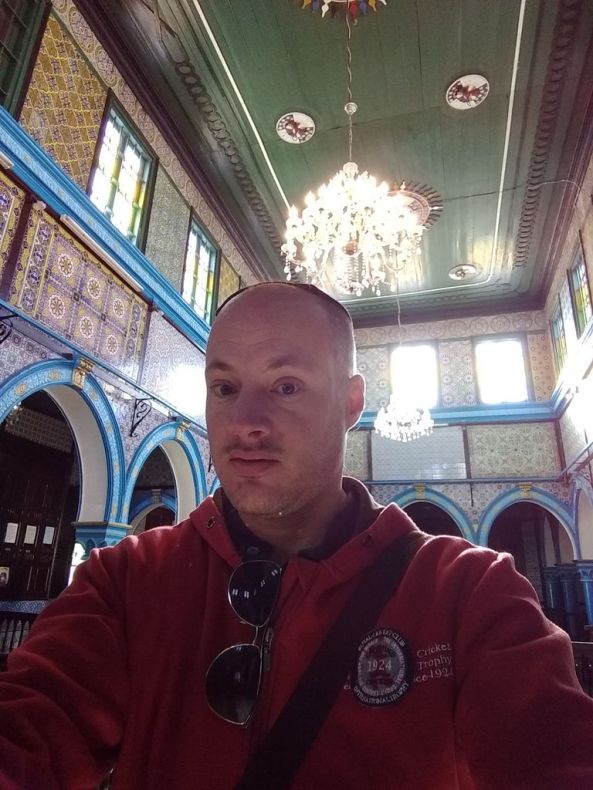
I really like this place.   Djerba’s El Griba Synagogue is one of these most unusual and famous synagogues in the world.   It was built at the 19th century, although its not particularly big.
DSCF1002 1024 DSCF1001 1024

DSCF1003 1024

DSCF1005 1024 DSCF1004 1024

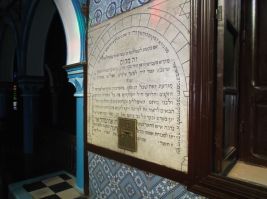
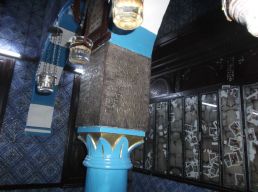
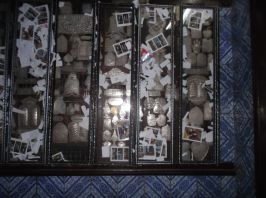
The glass cabinet thing top right appears to have prayer requests similar to the Kotel (Western Wall) in Jerusalem.

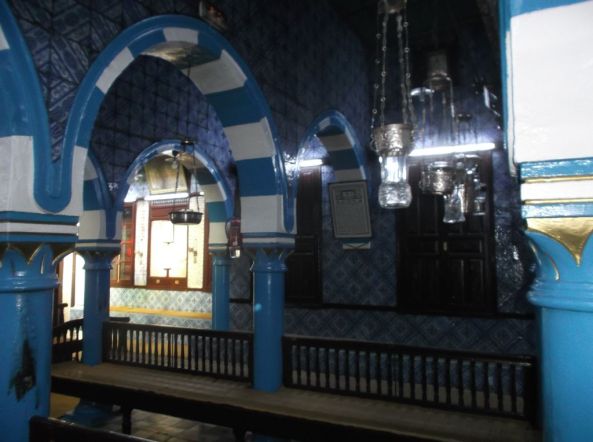
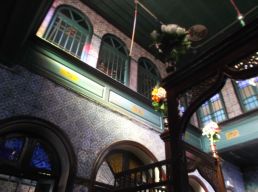
The wooden bannister around the synagogue has some flowers attached to it.  The blue and white stripes around the archways.

Things I learned about the Jewish community of Djerba:-

  1. Almost all Jewish men don’t seem to have beards
  2. You have to take your shoes off and wear a Kippur (if you are a man) when visiting the synagogue.  Removal of shoes is common in Muslim religious places and in homes of east Asian countries such as Japan, but the first time I’ve seen in a Jewish community.
  3. There are groups of Israelis who come and visit here each year (more on that later and Israel and Tunisia relations)
  4. Many of the Jews have jewellery shops in Hamout Souk in the north part of Djerba, alongside Muslim jewellery shops.   More soon.
  5. The men were singing prayers when I visited this place, later when I was reading an article elsewhere, I saw the face of the man I saw here, he comes and prays every single day.
  6. There is strict security to get into the synagogue following some terror attacks in the past, relatively rare, but two tragic incidents did happen.
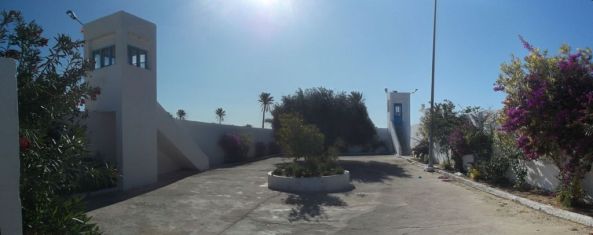
  7. synagogue garden 1024The garden at the back of the synagogue is quite pretty with a big olive tree, and several of these tall look-out posts.
  8. There are only approx 1,000 Jews left in Djerba, most families have 6-7 children, which means probably there’s a relatively small number of families who are quite big in number I think.
  9. You have to drop in 1 dinar (UK 30p) minimum to visit the Synagogue.    Of course, it is closed to visitors on the Sabbath, as its a fully functioning house of worship as opposed to this one in Fez, Morocco which is beautifully restored but empty.
  10. There were some Muslim women who had come just to visit.
  11. There were very few visitors in the synagogue as I’m here in November so there were no more than 6-7 people there when I visited.

This is truly an amazing looking religious temple with a variety of colours, textures and character like no other.

1. Plans – 2. French Connection – 3. My hotel in Djerba – 4. El Griba synagogue outside – 5. El Griba synagogue inside – 6. Markets – 7. Christianity in Tunisia – 8. Ferry to mainland Tunisia – 9. Getting to Matmata, Tunisia – 10. Sidi Idris Hotel New Hope Star Wars filmset – 11. Secrets I learnt about the famous Matmata Star Wars set – 12. Cave homes for would-be Jedis – 13. More what you don’t see in Star Wars at Hotel Sidi Idris – 14. How hospitable is Sidi Idris? – 15. ATM machines and drought – 16. Matmata Nouvelle (New Matmata) – 17. Tunisian butchers and fisherman – 18. Libyan and Algerian neighbours – 19. Jewellery businesses in Djerba – 20. Tunisia and Israel relations – 21. Hara Kebira, Jewish school, soap and TV repair shops – 22. Jewish community of Hara Kebira – 23. Going home
 

Djerba, Tunisia trip – 4. El Griba synagogue outside

el griba pano 1024

mosque nr griba1024

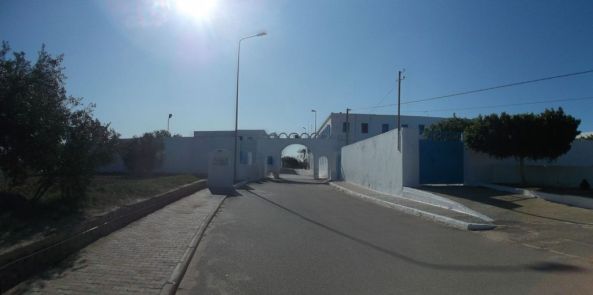
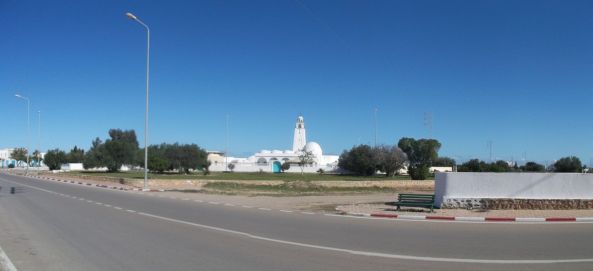
One of these is a synagogue and one is a mosque a short walk away, actually, apart from the tower, they aren’t that different from the outside.   Many of the old buildings in Tunisia are white and blue and little domed roofs including once not used for religious practice.

For me as a Christian, I’ve worked quite closely with Jewish people.  After living in Israel, one of the reasons I wanted to visit this Tunisia, is I believe it is one of the last few mostly Muslims nations which still has a Jewish community left.

When I visited Morocco in 2015, I visited there to see a now deserted Jewish community, synagogues, cemeteries, and implements used with Jewish holidays in second-hand stores – but no Jews left.   Tunisia had 100,000 Jews and Morocco had 260,000 in the 1950s, today there are around 1,000 Jews in Djerba and 500 in Tunis the capital.

IMG_20191117_100708457 1024

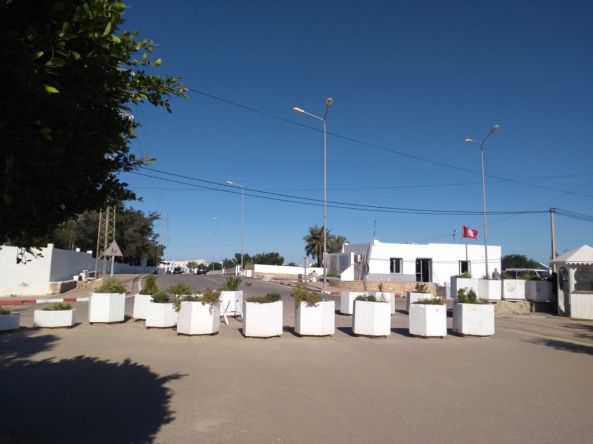
With the synagogue behind me, these plant pots are there to prevent car-ramming attacks, something Israel has implemented quite a lot, and European cities have experienced car ramming by Islamic terrorists in recent years have had to plan also.

DSCF1032 1024

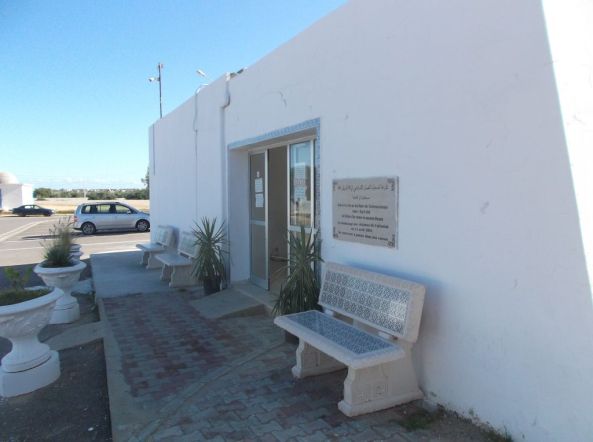
DSCF1030 1024Visiting the synagogue requires going through a checkpoint due to a couple of tragic terror incidents in the past.   This isn’t that much of an inconvenience, just putting bags through an x-ray machine and walking through a door frame metal detector.

Inside this place looks amazing and very different…

1. Plans – 2. French Connection – 3. My hotel in Djerba – 4. El Griba synagogue outside – 5. El Griba synagogue inside – 6. Markets – 7. Christianity in Tunisia – 8. Ferry to mainland Tunisia – 9. Getting to Matmata, Tunisia – 10. Sidi Idris Hotel New Hope Star Wars filmset – 11. Secrets I learnt about the famous Matmata Star Wars set – 12. Cave homes for would-be Jedis – 13. More what you don’t see in Star Wars at Hotel Sidi Idris – 14. How hospitable is Sidi Idris? – 15. ATM machines and drought – 16. Matmata Nouvelle (New Matmata) – 17. Tunisian butchers and fisherman – 18. Libyan and Algerian neighbours – 19. Jewellery businesses in Djerba – 20. Tunisia and Israel relations – 21. Hara Kebira, Jewish school, soap and TV repair shops – 22. Jewish community of Hara Kebira – 23. Going home
Djerba, Tunisia trip – 3. My hotel in Djerba

After getting off the plane, I’m only 7 or 8km from Houmt Souk, the main city on this island.

The yellow Dacia taxi that took me there had to just drive in a straight line through a empty main road, so the driver put his headlights on fullbeam and straddled both lanes, and I watched as I saw the speedo needle creep up and up as he put his foot down until I saw it pointed to 120kph.

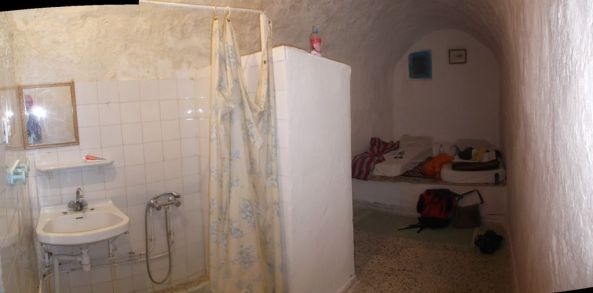
My hotel is very cheap but could be considered quite primitive…

djerba hotel 1024

DSCF0952 1024I have an ensuite bathroom – without a toilet.  There are these two beds, a mattress on top of a stone shelf, but quite a comfortable temperature actually.    Tunisia climate is pleasant in November.   In the morning the Islamic call to prayer comes into my window a bit earlier than I would prefer.

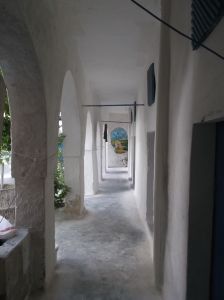
Outside is a pleasant court yard with some trees, and a simple table as there is dinner which I had couscous and beef included in the £5/night cost of the room, as well as breakfast of some French bread and jam and coffee.

DSCF0946 1024

1. Plans – 2. French Connection – 3. My hotel in Djerba – 4. El Griba synagogue outside – 5. El Griba synagogue inside – 6. Markets – 7. Christianity in Tunisia – 8. Ferry to mainland Tunisia – 9. Getting to Matmata, Tunisia – 10. Sidi Idris Hotel New Hope Star Wars filmset – 11. Secrets I learnt about the famous Matmata Star Wars set – 12. Cave homes for would-be Jedis – 13. More what you don’t see in Star Wars at Hotel Sidi Idris – 14. How hospitable is Sidi Idris? – 15. ATM machines and drought – 16. Matmata Nouvelle (New Matmata) – 17. Tunisian butchers and fisherman – 18. Libyan and Algerian neighbours – 19. Jewellery businesses in Djerba – 20. Tunisia and Israel relations – 21. Hara Kebira, Jewish school, soap and TV repair shops – 22. Jewish community of Hara Kebira – 23. Going home
Djerba, Tunisia trip – 2. French connection

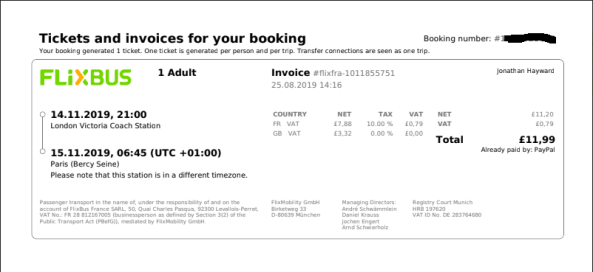
My journey from London to Paris might be the cheapest journey across water to another nation ever.

bus ticket

I like Flixbus, it is a German-owned coach company that joins many different European main cities together.    I didn’t even know that this journey existed cross-continent.  I used Flixbus to go from Vienna to Bratislava to Budapest, an emergency Luxembourg to Brussels last year after an airline strike.

This trip avoids to £40-200 fee of the Eurostar as a passenger, instead, the bus can drive onto a huge carriage of the train.   The downside is this journey is over eight hours overnight and try to sleep in a funny sort of position which made me wake up with cramp.   During the journey, you have to get off the bus and do the formal process of  passport check-in and have time to use the loo and get coffee (from a vending machine)

DSCF0943 1024

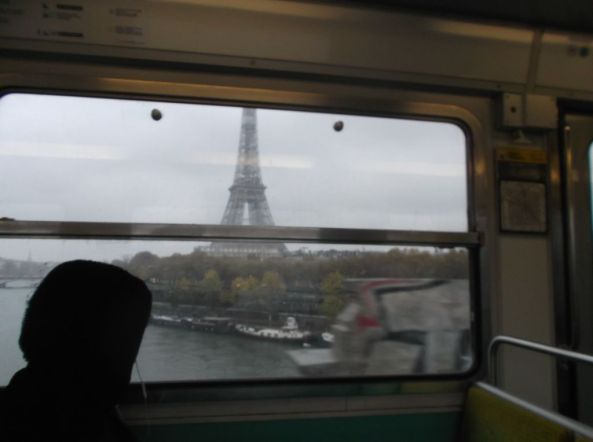
I like the Paris metro.   If the London Underground was this cheap, then I’d save enough from my commute to work for another trip.  You can get to see a few famous landmarks from a distance.

DSCF0941 1024

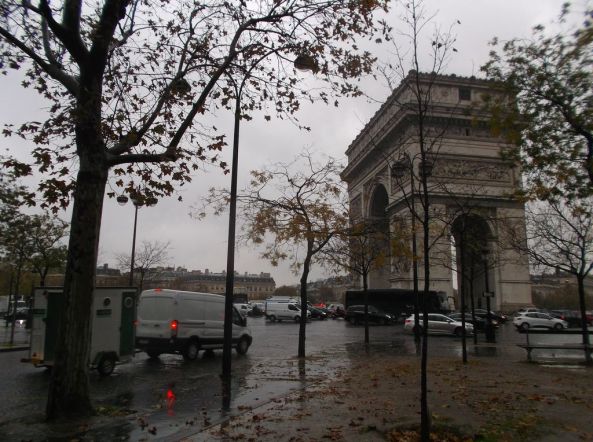
The Arc De Triomphe is interesting, mainly as I have seen a Spanish have a clone of it in Barcelona, and I think there is another one in Bucharest, Romania.   The most curious thing is no lines between traffic lanes so it’s not obvious how many vehicles can encircle this monument.

I think France has some strict laws on pollution, so older cars including classic French vehicles are absent, this is in contrast to elderly French automobiles which are everywhere in North Africa.   So from another train, I go to Orly airport south of Paris I got my flight to Tunisia.

1. Plans – 2. French Connection – 3. My hotel in Djerba – 4. El Griba synagogue outside – 5. El Griba synagogue inside – 6. Markets – 7. Christianity in Tunisia – 8. Ferry to mainland Tunisia – 9. Getting to Matmata, Tunisia – 10. Sidi Idris Hotel New Hope Star Wars filmset – 11. Secrets I learnt about the famous Matmata Star Wars set – 12. Cave homes for would-be Jedis – 13. More what you don’t see in Star Wars at Hotel Sidi Idris – 14. How hospitable is Sidi Idris? – 15. ATM machines and drought – 16. Matmata Nouvelle (New Matmata) – 17. Tunisian butchers and fisherman – 18. Libyan and Algerian neighbours – 19. Jewellery businesses in Djerba – 20. Tunisia and Israel relations – 21. Hara Kebira, Jewish school, soap and TV repair shops – 22. Jewish community of Hara Kebira – 23. Going home
Speciality Hebrew Roots bibles or tried and tested bibles?

Is it worth getting a Hebrew Roots type bible?

Since before I lived in Israel between 2009-2013, I’ve seen these speciality bibles that intend to appeal to those studying the scriptures to show a deep meaning of the original language.

David Stern’s Complete Jewish Bible.

David Stern is a nice elderly gent who is an American born Messianic Jew living in Israel. I think I saw him make an appearance a few times at King of Kings Jerusalem.

Some people get excited that this could be an ultra-authentic translation.  Really, this bible has words converted into transliterated Hebrew, and it’s intended for an Orthodox Jewish audience.   So for Orthodox Jewish community who find Yeshua, this would be wonderful to make the New Testament close to what they are used to, but I’m not sure of many people using it as a primary bible

Aramaic New Testament Bible
The Aramaic New Testament Bible is written by a chap called Andrew Gabriel Roth. Back when I was in Jerusalem I met a friend who knew this guy, and the bibles were around $70 (!) each, the quality of the cover and binding seems pretty good, but what about the translation?

People who were selling these told me the author is trying to persuade people that the New Testament is not originally Greek but Aramaic. This is quite a bold claim, as every Christian scholar I know anywhere will tell you that the NT was written in Greek, but does have portions of Aramaic in it, especially Jesus’ crucially important words like “Talita Kumi” (Little girl arise!) and “Eli Eli Lama Sabachtani?” (My God my God why have you forsaken me?)

Mr Roth I think is closely connected with the Refiners Fire website which is overly heavy type Hebrew Roots teaching site which has some good articles but very harsh and critical of everyone’s teaching that isn’t their own.   I spoke to a friend of mine who is a son of someone in leadership in an Israeli congregation asking about this version. He told me, he didn’t say anything bad about this particular bible, but that no one knows of Roth’s background, where he studied or why he should be credible in this subject. Hmmm.

My experience is that good scholarship and Christian ministries do not operate as a ‘lone wolf’ type thing and live as hermits on a farm somewhere, they operate in tandem with other churches and ministries, and all the good Messianic and Christian organisations do in Israel.

Amongst believer friends I know and respect, I know of very few people who use these versions, I think they might have been bought on a whim once but sit unused on a shelf and people would stick to more established bibles and refer to Strong’s concordance (I like it as part of biblehub.com) in print or electronic.

Why am I writing this? Am I heresy hunter? I’ve spoken to people online quite a lot, and people near me who have been distracted by some odd teaching, including two different friends of mine here in London who have mental health issues and is easily swayed by dubious stuff.

My thinking is this, does this make the scriptures more credible to their targeted audience, does it build up the reader, increase understanding of the word and offer extra value to the word of God? or does it just encourage arguments and splits??

Personally, I’d recommend Christians and Messianic Jews would give these books a miss and stick to a tried and tested translation. It is worth learning the Hebrew language from a trustworthy source though, you can find some fascinating things in it.  For me, to get a deeper and meaningful value from the Hebrew or Greek, I use Strong’s concordance, so I think I’m going to buy a real one to use for regular devotionals.

This is a great place to get a bible!  Cars aren’t allowed in Jaffa Street, so this is the Google cameras will show.

This shop in Jaffa Street in Jerusalem has a wide variety of them in Hebrew, English, Arabic and others too!

I’m going to bust the “sacred names” theology later in my explanation of my experience of Messianic congregations in Israel a little later.

What I learned and love about the Israeli Messianic community – 3. Meeting place names

So in the first parts, I’ve explained how the buildings used by Messianic Jews in Israel can be quite different just as much as traditional Christianity and traditional Judaism.

So is a building where they meet known as a church or a synagogue?

I’ve heard my Israeli Messianic believer friends use either occasionally, but actually, they are more likely to refer to a place as a ‘congregation’ in English or a Kehilat (קהילת) in Hebrew.

In fact, the main news site for believers in Jesus/Yeshua in Israel is called Kehilat News that gives English and Hebrew announcements of what’s happening in the land.

https://kehilanews.allisrael.com/

This is a great go-to site for the Messianic community for teaching, worship concerts, events and more.

1. Buildings 2. Christian or Jewish? – 3. Meeting place names4. Languages – more soon…..

Djerba, Tunisia trip – 1. Plans

10 years ago I finished doing an IT work in the Portsmouth and Southampton areas of UK where I am from, to go and volunteer in Jerusalem Israel helping a Christian charity helping Jewish people.

Since then, I like to go on small trips to different places, but particularly with places of religious significance, as well as lots of parts of Israel where I lived between 2009-2013, I’ve seen amazing Christian places in Turkey, and Jewish places in the diaspora in Europe, and more exotic places like Fez Morocco.

So I am excited to be going to Tunisia in November 2019.

Djerba is where I am going to.   Its an island connected to the west coast of this North African nation.

I really want to find out about:-

  • The small remaining active Jewish community which was this island is most famous for.   Possibly the very last thriving Jewish community in a Islamic country.
  • Star Wars filming locations, Luke’s village in the original 1977 New Hope is not far from here in a village called Matmata
  • How the tourism industry operates since threats of terrorism and recent collapse of British tour operator Thomas Cook
  • Food
  • Is their Christians there in the past or today
  • Landscapes especially The Sahara Desert
  • What do Muslim and Jewish people think of Star Wars

I thought this place would be extremely close culturally to Morocco, but from the research I’m doing, they are quite different, although both are French and Arabic speak Muslim nations.

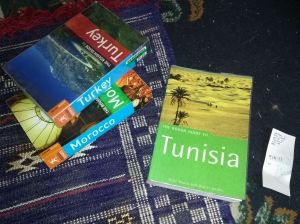
IMG_20190928_104741694They are not many recent travel books.   This Rough Guides I found on ebay is from 2001, doesn’t appear to be a more recent one, and seems to have come from a library.

1. Plans – 2. French Connection – 3. My hotel in Djerba – 4. El Griba synagogue outside – 5. El Griba synagogue inside – 6. Markets – 7. Christianity in Tunisia – 8. Ferry to mainland Tunisia – 9. Getting to Matmata, Tunisia – 10. Sidi Idris Hotel New Hope Star Wars filmset – 11. Secrets I learnt about the famous Matmata Star Wars set – 12. Cave homes for would-be Jedis – 13. More what you don’t see in Star Wars at Hotel Sidi Idris – 14. How hospitable is Sidi Idris? – 15. ATM machines and drought – 16. Matmata Nouvelle (New Matmata) – 17. Tunisian butchers and fisherman – 18. Libyan and Algerian neighbours – 19. Jewellery businesses in Djerba – 20. Tunisia and Israel relations – 21. Hara Kebira, Jewish school, soap and TV repair shops – 22. Jewish community of Hara Kebira – 23. Going home
What I learned and love about the Israeli Messianic community – 2. Christian or Jewish?

In my first part, I described how the building styles for gatherings for Jewish believers in Jesus can vary quite a bit.

So are Messianic Jews

  • Jewish or Christian?
  • Both?
  • Somewhere in between?

I think about 99% of all the first generation believers during the time of Jesus were Jewish.   The handful that wasn’t, is the Syrian-Phoenician woman and the Roman soldier whose servant were sick, who Jesus healed. Matthew 15:21-28 / Luke 7:1-10

So today’s Messianic Jewish movement in Israel is the same.   They are modelled on first-generation Christians, who were Jewish.

They are from a wide variety of backgrounds.

This road in Israel points towards Damascus – not that you can get there now, but its a thought of where Paul was journeying to.

Paul made things different, as he was a scholarly and traditional religious Jew who on a road I imagine like this heading the direction of Damascus after becoming temporarily blind, then having a real-life encounter with Jesus, U-turned his life from being a Jew antagonising followers of Jesus, to a pioneer of the gospel of Jesus to the mostly to the gentile world.

From clothing and physical attributes, Messianic Jews stand out less than Orthodox Jews who have instantly recognisable clothing like black hats, jackets and white shirts for the ultra-orthodox, and kippors worn by traditional orthodox.   Messianic Jews, for the most part, tend to wear more plain clothing.

Christians who live in Muslim countries are often persecuted.  In Israel, there is some degree of persecution to Messianic Jews, as they are considered not yet proper by many religious Jews, but generally, Messianics are used to this and tend not to draw attention to themselves.   For Messianic Jews from other countries making Aliyah, the formal process of immigration to Israel from another country can be difficult as the fact they are believers in Jesus could get them declined.   Immigration can be done, its just a little more complex, with some discretion required.

Messianic Jews in Israel all observe the Sabbath and Jewish holidays, most will speak Hebrew, and almost all will have family in the army or full-time employment and pay taxes.

Jews in Israel are made up of any of these, and Messianics can be found in these groups.

  • Ashkenazi – European / America / Canada / Australia / Russia
  • Mizrahi – Mahgreb (Morocco and North Africa) / other Middle east (Yemen, Iraq, or native Israeli)
  • Sephardic – Spanish / Latin American / Other Middle east
  • Falasha – Ethiopia
  • Or, a family of a combination of any of the above
  • Or, parents of a mixture of above Jewish descent and western gentile Christians

Jewish people of all kinds have suffered persecution under people calling themselves Christians.    Where it pains me to see this, we also know that Messianic Jews were also sent to the holocaust camps as well.  Because of this, there is much concern from Jewish people from some history which needs to be reconciled.

My Messianic Jewish friends in Israel generally cope well with some of the challenges of these things, but they would all consider Israel to be their home and wouldn’t want to live anywhere else.

What I learned and love about the Israeli Messianic community
1. Buildings – 2. Christian or Jewish? – 3. Meeting place names – more soon…..

What I learned and love about the Israeli Messianic community – 1. Buildings

While I lived in Jerusalem, I found that Christians and Messianic Jews living there would host travellers and people doing short term projects.   This gives you a unique angle for visitors who both love Jewish people and the Jewish Messiah.    So after being there a few months, I was encouraged to do the same, often I was asked to show around someone who is new to doing volunteering work, see interesting places like Jerusalem’s old city, the Kotel, good places to eat out, but also somewhere to fellowship at the weekend.

Now imagine this.   New visitors have often told me how this congregation looks like a ‘normal church’ or doesn’t feel authentic.    Or, in the case of June of 2019 an angry-sounding woman commented on my blog tells me any congregation that isn’t her perceived style is pagan and “doing it all wrong”.

I got thinking, how do I reach out to these sorts of people to understand what I learned from the Messianic community in Israel?    I think its quite different from how people perceive what’s an ideal place to have fellowship.

Different religious buildings can be on a scale, one end of this scale is traditional and other is modern.   Let’s look at some well known examples:-

This St Paul’s Cathedral in London

This is the Dominion Theatre in London, its borrowed by Hillsong church on sunday

In conventional churches in the UK, these can have stained glass windows, giant organs set into the building, pews and similar decor.  Or, some can be modern places with car parks, modern kitchens and a stage with a projector for song lyrics.

Jerusalem Great Synagogue, Israel

Here is the #2 biggest synagogue in the world in Budapest Hungary

In traditional Judaism, you will see buildings with pews also, which I think facing three sides of a square, some nice hanging brass lamps and lots of wood panelling everywhere. Also like modern Christianity, some synagogues will be new buildings with more emphasis on practicality and comfort and have a sophisticated AV system.

Neither traditional or new is wrong, they are just two different styles of how things are done.    Some buildings will be owned and some will be rented off someone else.

The Messianic movement in Israel is relatively new (modern Israel is only 71 years old) and the body of believers is small 20,000-30,000 people.  So congregations are small and budgets for a building are small and will usually rely on donations from other places, ie: Christian friends from other parts of the world.

So, therefore, Messianic congregations can vary quite a bit also in style.

I think I’ve visited 8 different Messianic congregations, one Arab congregation and 2 house type churches.  Here’s an example of a few well known ones:-

Here is Christchurch congregation inside the Jaffa Gate in Jerusalem, Israel.  Like a traditional-looking church but has services in Hebrew, Arabic and Russian.

Here is Kehilat HaKarmel near Haifa.   This is maybe the closest you will see to a Jewish Synagogue, it has an amazing custom-designed building, but I love the community, teaching and the outreach work that has been done there also.

This is King of Kings congregation in the Clal building.  This is a shopping mall with the congregation in the basement which is a converted cinema, and the 16th floor if you look up hosts prayer conferences in smaller gatherings.   This congregation has a big stage, theatre type sound and lights, and often used for hosting international speakers.   Teaching and worship is great too!!   This was my main source of fellowship.    Door is to the left to with the green stickers to the entrance of the shopping mall and you take some steps downstairs.

This is the Shelter Hostel in Eilat, this congregation is more look a house church but is a functioning youth hostel for any type of traveller (like me) with staff to run the place but also has optional bible study and worship on Shabbat.

This Jerusalem Assembly.    This is the most likely type of building I think believers meet in.    An ordinary office block.    Looks a little scruffy from the outside, but it has been painted up nicely inside.  
All these places are authentic places for worship, the building shape and style doesn’t always matter, but these all provide bible teaching and worship for Jewish believers in Yeshua in different parts of Israel.
What I learned and love about the Israeli Messianic community

Jerusalem hotel entrance and perspectives on the Gospel

See this? this is the Mount Zion Hotel in Jerusalem.  Spin around, and you can see some nice scenery, look for the four flag poles on the right. (use your computer, probably won’t work so well on a phone)  Also look at the English/Hebrew text on the side of the building.

Here is the same place, but different floor:-

This hotel I stayed in on my first ever trip to Jerusalem on a tour with my Dad in 2004.  I see this as an analogy to the way Jews and Gentiles see the gospel.

Look at the hotel from the top floor, on one side and it is next to Hebron Road, and you can enter it from there.   That’s right, the building has entrances from different floors, because like most of Jerusalem, it is built on the side of a hill.

It’s a little far away, you might need to zoom, but spot those 4 flag poles, there is another entrance which is several floors downwards.   The sign writing is also there.

I think of this, Jewish people read the Tanakh (what Christians call the Old Testament) could enter the hotel from the bottom floor.

Christians tend to be more familiar with the New Testament.   This is the top floor.   The two floors are connected together.

Imagine the building is the body of Christ.   We are one in Jesus/Yeshua, Jew and Gentile.

Romans 1:16 For I am not ashamed of the gospel, because it is the power of God that brings salvation to everyone who believes: first to the Jew, then to the Gentile.

Often observant Jewish people who know Yeshua (Jesus) as Lord and Saviour would of learn the Tanakh, and when reading the New Testament will find that this completes the prophecies in Zechariah, Isaiah, Jeremiah and more, from the very first book of Matthew explains Jesus family lineage from Adam to Abraham to Noah to King David all the way through.

For Gentile Christians, when reading the New Testament, then reading the Old Testament, told us the promise of the Messiah, the need for his atonement on the cross, Jesus’s Jewish background, and the New Covenant to come.

Both the OT and the NT also will harshly remind us of the past when mankind has been in sin, with idolatry and immorality.

This scripture doesn’t discard the Jewish people, not are Gentiles suppose to take up Jewish holidays and customs as an essential thing.  (actually, I like doing these when I visit Israel, or my Jewish friends in London)   Neither Jew or Gentile is more important than the other.   When understood right, salvation means we are one the Messiah.

Galatians 3:28 There is neither Jew nor Gentile, neither slave nor free, nor is there male and female, for you are all one in Christ Jesus.

Also, as I’m a languages nerd, I remember looking up a word ‘Bishara’ I heard in Arabic from someone reading the beginning of the book of Matthew; I found that in the Hebrew it is הבשורה (Ha Bishara) and Gospel in Arabic is Injila according to Google Translator, but the word I was looking for is actually “Good News” which is Bishara in Arabic.

I was just thinking about memories of this hotel and how the Jerusalems’s unique places made me think of the bible’s plans for us.